 and
and  [15]:
[15]:
Already in the first proposal period, we developed a generic activator-inhibitor reaction-diffusion model, which originally was derived for vertical charge transport through semiconductor structures like the HHED and which is typical for a large class of spatially extended systems in physics, chemistry and biology. Global coupling is achieved through the connected electric load circuit. This model exhibits not only front dynamics but complex and chaotic spatiotemporal scenarios as well [7]. During the report period we have obtained surprising results and have made substantial progress managing to control spatiotemporal patterns using time-delayed feedback methods (Pyragas-control [1,40]).
In dimensionsless units, the model equations for the generic model
have the form of a reaction-diffusion system of activator-inhibitor type, with global coupling.
We have extended the model by adding the control forces
and
[15]:
 is the space dependent activator variable
(electron density distribution in the layer vertical to the transport direction) and
is the space dependent activator variable
(electron density distribution in the layer vertical to the transport direction) and  is the inhibitor variable (voltage across the device). The first equation represents the continuity equation
for electrons that flow through the layer and the second equation is the Kirchhoff-equation
for the total current
is the inhibitor variable (voltage across the device). The first equation represents the continuity equation
for electrons that flow through the layer and the second equation is the Kirchhoff-equation
for the total current  , which causes a global coupling through the voltage drop
across the load resistance. The mean spatial charge density distribution
, which causes a global coupling through the voltage drop
across the load resistance. The mean spatial charge density distribution
 enters
into the current and represents the global coupling.
enters
into the current and represents the global coupling.
 ,
,  and
and  are system parameters, which represent the time scale, the external control
parameter or a parameter determining the bistability regime, respectively.
are system parameters, which represent the time scale, the external control
parameter or a parameter determining the bistability regime, respectively.
The spatial variable in the layer  can be one- or two-dimensional depending
on the problem. In the following we consider the one-dimensional case. The control forces
and
, each of which is multiplied by a control amplitude
can be one- or two-dimensional depending
on the problem. In the following we consider the one-dimensional case. The control forces
and
, each of which is multiplied by a control amplitude  , can be chosen arbitrarily.
![\includegraphics[width=\columnwidth]{HHED_KR}](img35.gif) |
First let  (no control). Complex and chaotic behaviour is expected in a parameter range for which,
at the same time, conditions for both a spatial instability (current filament) and a temporal one
(Hopf bifurcation) are satisfied, as we have shown in the one-dimensional case [7].
The question arises under which circumstances similar behaviour for systems of two spatial dimensions
is possible. In collaboration with guest scientist W. Just (London) as well as with project B6
we managed to show, using an amplitude expansion of the supercritical codimension-two-bifurcation,
that one should not in general expect a coexistence of Turing- and Hopf instabilities in two dimensions
in a (through a second diffusive coupling) locally coupled system unless the system size of the
two directions is so small that a quasi-onedimensional dynamics arises.
[10].
(no control). Complex and chaotic behaviour is expected in a parameter range for which,
at the same time, conditions for both a spatial instability (current filament) and a temporal one
(Hopf bifurcation) are satisfied, as we have shown in the one-dimensional case [7].
The question arises under which circumstances similar behaviour for systems of two spatial dimensions
is possible. In collaboration with guest scientist W. Just (London) as well as with project B6
we managed to show, using an amplitude expansion of the supercritical codimension-two-bifurcation,
that one should not in general expect a coexistence of Turing- and Hopf instabilities in two dimensions
in a (through a second diffusive coupling) locally coupled system unless the system size of the
two directions is so small that a quasi-onedimensional dynamics arises.
[10].
The generic structure of equations (1) and (2) is underlying for other projects as well. A very interesting collaboration arose with project B4, in which an electrochemical model for pattern formation in electrode surfaces was investigated: a detailed comparison to our globally coupled reaction-diffusion model revealed astonishing similarities in the scenarios of complex spatiotemporal dynamics [11]. Extending the globally coupled two-component reaction-diffusion system by a third diffusive component, one can describe apart form stationary, breathing or spiking current filaments, also moving filaments (or domains, respectively) [27].
Now we consider the case  in one spatial dimension.The system parameters are chosen such that
for
chaotic spatiotemporal spiking arises. Our aim is to stabilize an unstable periodic
spatiotemporal orbit, which is characterized by the period
in one spatial dimension.The system parameters are chosen such that
for
chaotic spatiotemporal spiking arises. Our aim is to stabilize an unstable periodic
spatiotemporal orbit, which is characterized by the period  and the Floquet exponents
  .
Furthermore the control forces
and
should vanish for successful control
(noninvasive control).
.
Furthermore the control forces
and
should vanish for successful control
(noninvasive control).
This can be achieved using variants of time-delayed autosynchronization (Pyragas-control)
[1,2,3].
Our goal here was to extend this method to spatiotemporal patterns.
As starting point we use a delay feedback loop of the form
 ,
,
 (diagonal coupling), with
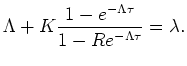
 is a memory parameter. For the diagonal control the Floquet-exponent
  of the controlled orbit satisfies the exact implicit equation [4],
values,
and a Hopf bifurcation for large
values.
Now it is interesting to examine how the control range deforms
when applying other control schemes. One example is local control without
inhibitor control, which arises for
of the controlled orbit satisfies the exact implicit equation [4],
values,
and a Hopf bifurcation for large
values.
Now it is interesting to examine how the control range deforms
when applying other control schemes. One example is local control without
inhibitor control, which arises for  ,
. In Fig. 1(b) one can recognize that thereby
new control boundaries arise. A systematic comparison of different local and global control schemes
has been performed by collaboration with W. Just (London) and J. Socolar (Duke University,
USA). There we could show, for instance by calculating the Floquet spectra, that
in Fig. 1(b) for large
and
, the control regime is bounded by a
subcritical flip bifurcation, and that for global control the control regime gets even bigger
if the inhibitor control is omitted.
,
. In Fig. 1(b) one can recognize that thereby
new control boundaries arise. A systematic comparison of different local and global control schemes
has been performed by collaboration with W. Just (London) and J. Socolar (Duke University,
USA). There we could show, for instance by calculating the Floquet spectra, that
in Fig. 1(b) for large
and
, the control regime is bounded by a
subcritical flip bifurcation, and that for global control the control regime gets even bigger
if the inhibitor control is omitted.
![\includegraphics[width=0.8\columnwidth]{bab02_fig_2}](img48.gif) |
![\includegraphics[width=0.8\columnwidth]{bab02_fig_3}](img50.gif) |
For applications, particularly interesting are control schemes which work
with the smallest possible amplitude factor
.
In this regard, a new control scheme which we developed
in collaboration with W. Just [14], has proven surprisingly efficient.
For this control scheme, the Floquet-left eigenmode
 and
the, associated with the adjoint problem, Floquet-right eigenmode
and
the, associated with the adjoint problem, Floquet-right eigenmode
 are calculated for the largest Floquet-exponent
of the orbit to be stabilized. A concrete example of such modes is depicted
in Fig. 2.
The control forces are then constructed as follows:
are calculated for the largest Floquet-exponent
of the orbit to be stabilized. A concrete example of such modes is depicted
in Fig. 2.
The control forces are then constructed as follows:
By applying this control force to the generic model, we discovered that
control works even for extremely small
-values, i.e.
the control threshold decreases by six orders of magnitude,
as demonstrated in Fig. 3
in comparison to diagonal control. Investigating this phenomenon in more detail,
we determined that a phase shift  of the controlled orbit over the phase
of the Floquet modes plays an important role which can be treated by perturbation theory
[14].
We also applied this new type of Floquet mode control to the Rössler-Model [24].
In this low dimensional system we succeeded in analysing the dependence of the minimal
control amplitudes of the phase shift
far beyond the perturbation theory Ansatz.
of the controlled orbit over the phase
of the Floquet modes plays an important role which can be treated by perturbation theory
[14].
We also applied this new type of Floquet mode control to the Rössler-Model [24].
In this low dimensional system we succeeded in analysing the dependence of the minimal
control amplitudes of the phase shift
far beyond the perturbation theory Ansatz.
With a suitable expansion of the Floquet mode control in two unstable modes, we succeeded for the first time to place localized spatiotemporal patterns (spikes) aimed at a chosen position of the system [14]. Whereas normally, stable or unstable spatiotemporal spikes in a globally coupled reaction-diffusion system with Neumann boundary conditions are pinned on the boundary of the system, we could stabilize the spikes for vanishing control force, with tended Floquet mode control, in the centre of the system. This involves the control of an unstable orbit on the repellor.




![$\displaystyle \alpha\left[j_0 - (u-\langle a\rangle)\right] -K F_u(t).$](img26.gif)











![$\displaystyle \int_0^L
\phi_a(x',t)\left[a(x',t)-a(x',t-\tau)\right]$](img56.gif) d
d![$\displaystyle x' +
\phi_u(t)\left[u(t) -u(t-\tau) \right]$](img57.gif)